
WASHINGTON 鈥� It changed Hollywood 鈥� and America 鈥� forever, opening the bedroom door to a sexual revolution, capturing coming-of-age themes of youth alienation, and stoking Baby Boomer rebellion against “plastic” 1960s parents:
鈥淚鈥檝e had this feeling ever since I graduated … that I have to be rude all the time.聽… It’s like I鈥檝e been playing some kind of game, but the rules don鈥檛 make any sense to me. They鈥檙e being made up by all the wrong people.鈥�
Now, returns to theaters for its in a 4K restoration presented聽by Turner Classic Movies and Fathom Events on both Sunday, April 23 and Wednesday, April 26.
It’s the perfect time to rediscover cinema’s most bizarre love triangle, as college graduate Benjamin Braddock (Dustin Hoffman) is seduced by older family friend Mrs. Robinson (Anne Bancroft), only to escape her clutches and pursue a relationship with her聽unknowing daughter Elaine (Katharine Ross).
The聽movie stakes countless claims as a聽classic: Simon & Garfunkel provided the first wall-to-wall soundtrack (from “The Sound of Silence” to “Mrs. Robinson”), Anne Bancroft delivered her career role as an antagonist聽for the ages, a debuting Dustin Hoffman became an overnight star, and Buck Henry and Calder Willingham penned a script filled with memorable dialogue (“One word: Plastics”).
But more than just a cultural touchstone, the film’s most important聽legacy聽remains its place as聽the Best Directed Comedy Ever Made. That’s right, I聽said it.聽Sure, there are pioneers (“Modern Times”), gender benders (“Some Like It Hot”), political satires (“Dr. Strangelove”), genre spoofs (“Blazing Saddles”), comedies of manners (“Annie Hall”) and laugh-out-loud antics (“Caddyshack”). But in terms of sheer symbolic imagery, nothing has ever come close to Mike Nichols’ Oscar-winning direction.
So as you head to the multiplex for the 50th anniversary, what should you be looking for?
We have a complete breakdown of Nichols’ brilliant directing techniques below:
(The following videos and screenshots courtesy of YouTube and Embassy Pictures)聽
Left vs. Right Screen Direction
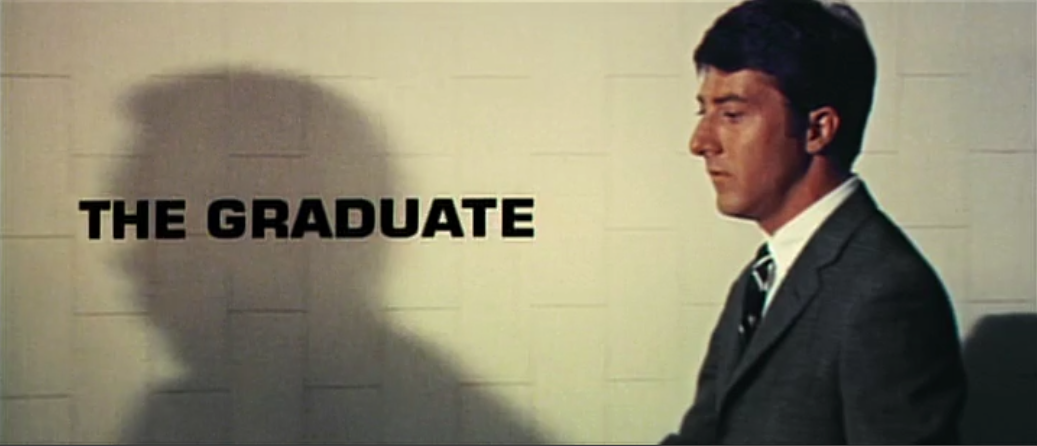
“The Graduate” is a master class right from the , where Benjamin rides to the left on an airport conveyor belt, while everyone else follows the strict P.A. request, 鈥淧lease stay to the right.鈥�
The political implications are聽obvious, as it’s no secret Hollywood is a left-leaning town. Writer Buck Henry himself told AMC’s “Movies That Shook the World” about his script’s theme: 鈥淗ow do I get away from my mother, father and their Republican friends?鈥� Regardless of your own political stripes in 2017, you’ve got to聽respect the artist鈥檚 ability to聽express his views creatively with screen direction.
Trapped Bars &聽Frame Invasion
After the opening credits, we find Benjamin聽hiding upstairs in his bedroom, escaping the chaos of聽his graduation party downstairs.聽You’ll notice that the vertical stripes on the wallpaper resemble jail bars trapping him. There’s also a dart board, which is how he feels being bombarded by聽the adoring adults.

His聽reprieve is interrupted by his father (William Daniels, a.k.a. Mr. Feeny from “Boy Meets World”), who sits down directly in front of the camera, crowding the frame and blocking our view of Benjamin.

When聽his聽mother (Elizabeth Wilson) arrives, she聽obscures聽the entire聽frame. The聽camera becomes so uncomfortable that it must pull back to escape, as Benjamin聽joins his parents to return downstairs.
Drowning Scuba Divers
In addition to the jail-bar wallpaper, you’ll also notice important symbolism regarding a fish tank. We first see Benjamin sitting with half-lit face 鈥� meaning he’s internally divided about his future 鈥� in front of his bedroom fish tank, where a miniature scuba diver points a weapon right at his head.
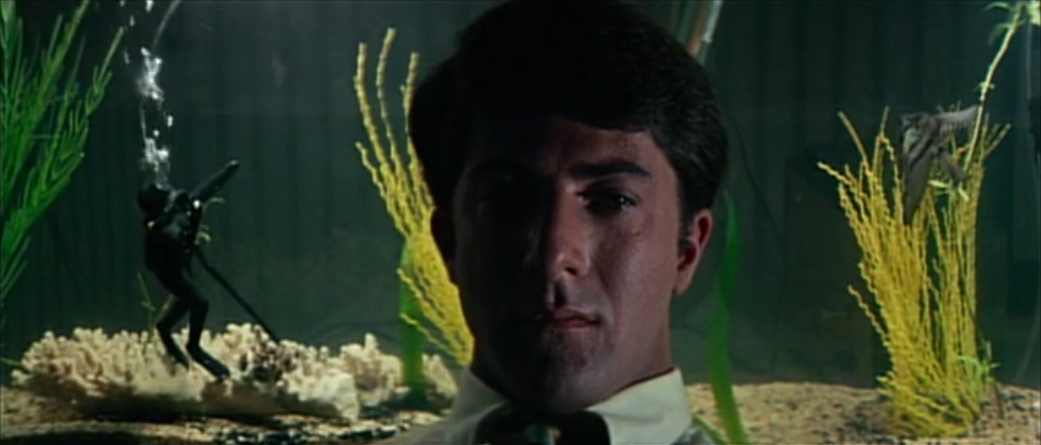
This foreshadows a later scene where Benjamin actually receives聽his own real-life scuba suit as his 21st birthday gift from his parents. As Ben reluctantly dons the suit (putting on a rubber), Nichols uses a POV shot from inside the suit as his parents palm his face mask and shove him underwater.
As the camera pulls back in the swimming pool and Ben becomes tiny in the distance, he not only resembles the scuba driver from the fish tank, he also symbolically drowns under parental pressures.

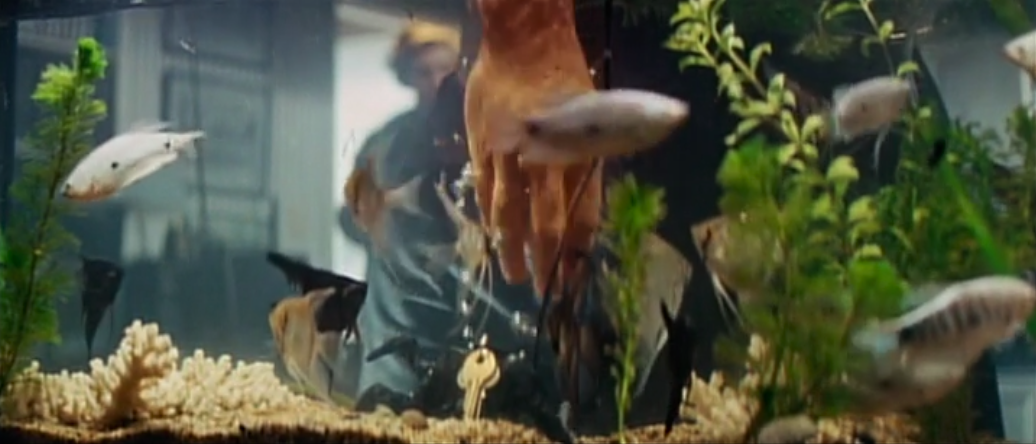
What’s the key to Benjamin’s escape? Mrs. Robinson tosses her car keys across the room, splashing into Benjamin’s fish tank. Where do they land? Right on top of the miniature scuba diver. Genius.
Tears of a Clown; Seduction of a Cougar
It’s this pressured mindset that allows Benjamin to become seduced by Mrs. Robinson.聽As Benjamin’s parents lead him downstairs, you’ll notice a picture of a frowning clown on the wall. Nichols then cuts directly to Benjamin’s identical expression. The image recalls聽Smokey Robinson’s “Tears of a Clown.”
Fittingly, it was also Smokey who sang, “Take a good look at my face, you’ll see聽my smile looks out of place.” Those lyrics parallel Benjamin’s response to his parents’ friends: “What are you going to do now?” “I was gonna go upstairs for a minute.” “I meant with your future!” “That’s a little hard to say.”


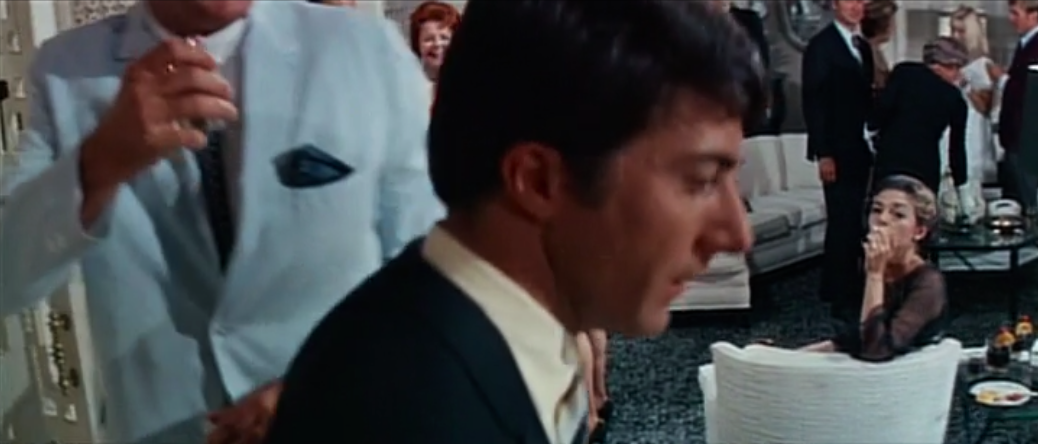
It’s this phony face that Benjamin carries with him to the party downstairs. During a masterful single-take where Ben’s parents swarm him with questions, Nichols takes the time to pause and reveal Mrs. Robinson sitting in the background, staring at her young prey during his vulnerable quarter-life-crisis.
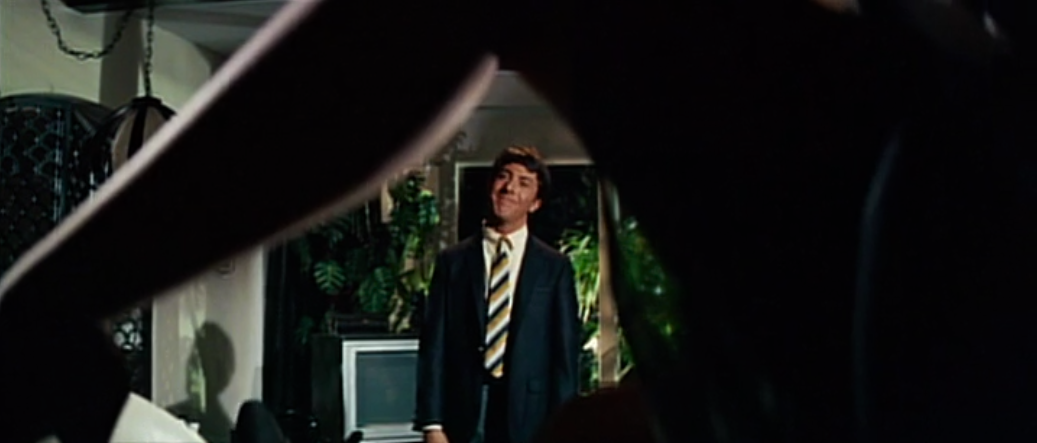
The seduction is officially achieved when Benjamin drives Mrs. Robinson home, the camera cutting to the now-iconic shot beneath her leg as Benjamin says, “Mrs. Robinson, you’re trying to seduce me.”
Generational Reflections
The first time Benjamin goes upstairs at the Robinson home, he enters Elaine’s room to fetch Mrs. Robinson’s purse. While Ben stands in 苍辞颈谤颈蝉丑听silhouette, Elaine’s portrait is highlighted on the wall.
It’s no accident that Mrs. Robinson first appears nude in the portrait’s reflection,聽foreshadowing the cross-generational love triangle聽with a commentary on aging聽to rival聽“The Picture of Dorian Gray.”
When it later comes time for Benjamin and Mrs. Robinson to consummate their affair at the hotel, an inverted reflection appears聽on聽the lobby bar table聽to signify Ben’s world being turned upside-down.
Transitions & Cuts
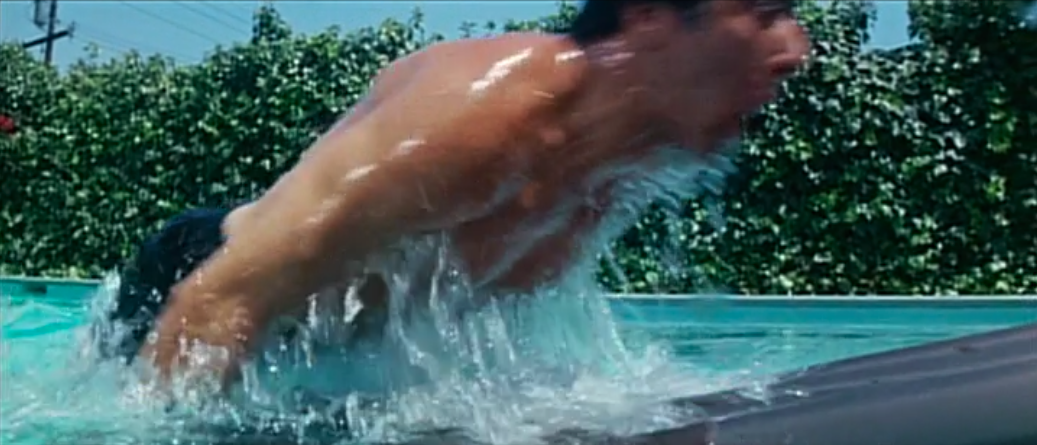
After Benjamin goes through with the affair, Nichols embarks on a series of montages to capture the endless drifting of his summer fling: lounging in the pool by day, sleeping with Mrs. Robinson by night.
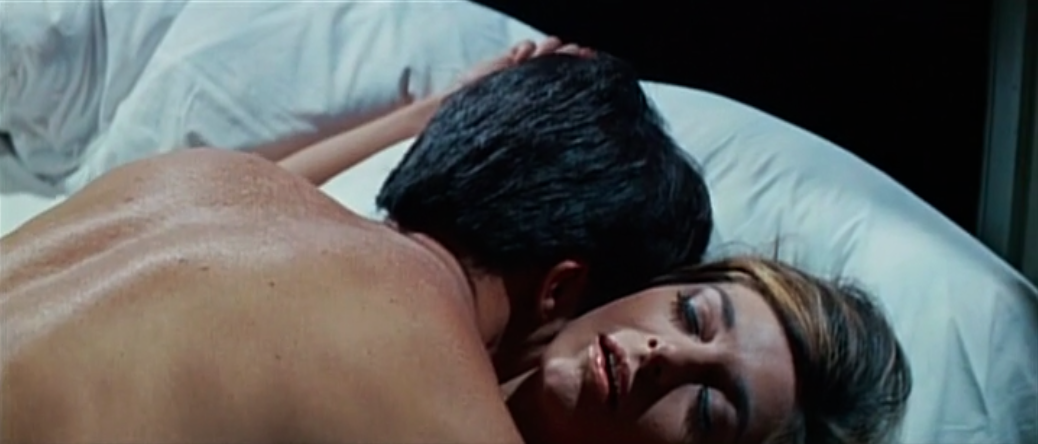
Note how Ben changes locations, leaving one particular space and entering another, leaving the pool house then cutting to enter Mrs. Robinson’s hotel room. In one moment, his head lays against the black headboard of the hotel room, then suddenly cuts to his head on a black pillow as he watches TV.
The montage builds and builds until its finest moment, as Nichols shows Benjamin leaping onto a pool raft then cuts to him landing on the hotel bed with Mrs. Robinson. Lying on top of Mrs. Robinson, he suddenly hears his father’s voice and turns to look up, returning us back to the swimming pool POV.
Rack Focuses聽& Damning Zooms
Of course, these two philanderers must pay for their sins. This powerful moment comes after Ben falls for Elaine. During a torrential downpour, he races to the Robinson home to tell Elaine the truth.
Standing in the bedroom doorway, you’ll notice the camera starts with Elaine’s face in focus, before “rack focusing” to Mrs. Robinson in the background, then聽racking back to focus on Elaine’s face. Her face symbolically comes into focus as she realizes the shocking truth and screams at聽Ben to leave.
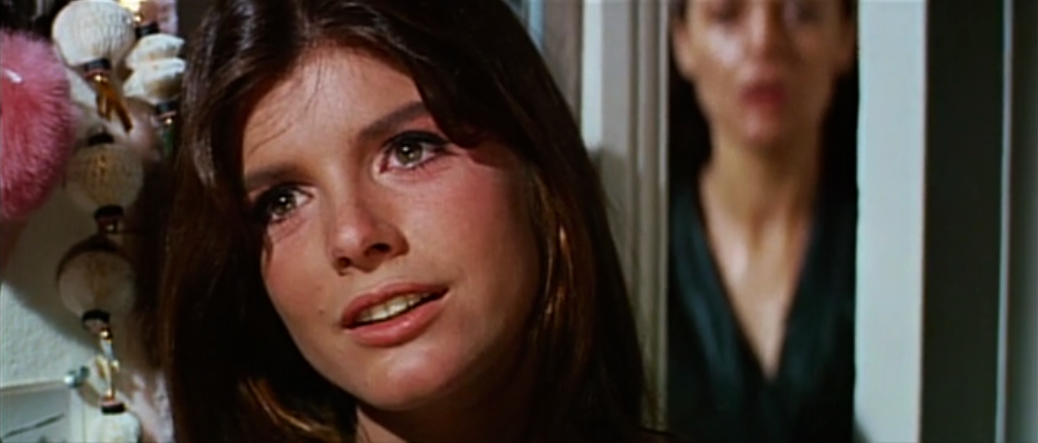
Embarrassed in the hallway, Ben turns his attention to Mrs. Robinson, who stands disheveled in the corner and says, “Goodbye, Benjamin.” It’s here that the camera zooms out in exaggerated fashion, leaving Mrs. Robinson聽small in the distance, symbolizing her emotional state at this pathetic聽moment.
Jesus Loves You More Than You Will Know
Eventually, Benjamin and Elaine find redemption, as Ben interrupts Elaine’s wedding by tapping on the glass in crucifix form. As Elaine leaves her would-be groom at the alter to run off with Benjamin, Mrs. Robinson yells,聽鈥淚t鈥檚 too late!鈥� to which Elaine defiantly replies, 鈥淣ot for me!鈥� Mrs. Robinson slaps her, not because she鈥檚 being rebellious, but because deep down she knows that Elaine is right.
It’s here that the crucifix symbolism really ramps up, as Benjamin swings a giant cross at the adults, then uses it to lock the doors, trapping the religious hypocrites (i.e. Pharisees) inside the church.
Is the imagery聽a blasphemous聽stick-it-to-the-man statement against a religious establishment? Or is it a protective sword for true righteousness,聽declaring, 鈥淛esus loves you more than you will know?鈥� After all, that’s the chorus to Simon & Garfunkel’s legendary “Mrs. Robinson.” Fascinating stuff.
Uncertain Future: Ambiguous Finale
From here, the film ends in the most ambiguous of ways 鈥� like the best of poetic movies聽鈥� as聽Ben and Elaine flee the church to board a bus. As they sit in the back of the bus, the camera holds in a static shot聽as their facial expressions change. At first, they both smile ear-to-ear, happy at their decision.

Seconds later, we see Elaine still smiling as Benjamin’s smile noticeably fades.

Then, Elaine’s smile fades as Benjamin convinces himself to smile.

Finally, both young lovers look down and dejected, unsure聽whether they made the right decision.

Conclusion
For all this, Nichols won Best Director against the toughest competition of any year: Arthur Penn’s “Bonnie and Clyde,” Norman Jewison’s “In the Heat of the Night,” Stanley Kramer’s “Guess Who’s Coming to Dinner,” Richard Brooks’聽“In Cold Blood” (1967) and聽Stuart Rosenberg’s “Cool Hand Luke.”
What’s all the more mind-boggling is that this level of artistry came from聽the year’s top-grossing movie. Adjusted for inflation, “The Graduate” remains the No. 22 highest grossing movie of all time, just behind “Raiders of the Lost Ark” (1981) and several slots ahead of “The Godfather” (1972) and “Forrest Gump” (1994). How often does a top-grossing teen movie win Best Director these days?
Indeed, “The Graduate” is more than just a teen comedy. It’s聽a social commentary warning us about silent conformity and plastic commercialism. In the words of the film’s opening track: “‘Fools,’ said I, ‘You do not know. Silence like a cancer grows. Hear my words that I might teach you. Take my arms that I might reach you.’ But my words like silent raindrops fell, and echoed in the wells of silence.”
Fifty years later, have we as a society listened to the lessons of “The Graduate?”聽To a certain extent, you聽might argue that “we the people” have ignored the film’s warning and embraced the opposite:
“And the people bowed and prayed, to the Neon God they made.聽And the sign flashed out its warning,
in the words that it was forming, and the sign聽said, ‘The words of the prophets are written on the subway walls, and tenement halls, and聽whisper’d in the sounds of silence.'”
Here’s to the聽lowly prophets who creatively聽write聽on the subway walls for each new generation.


